


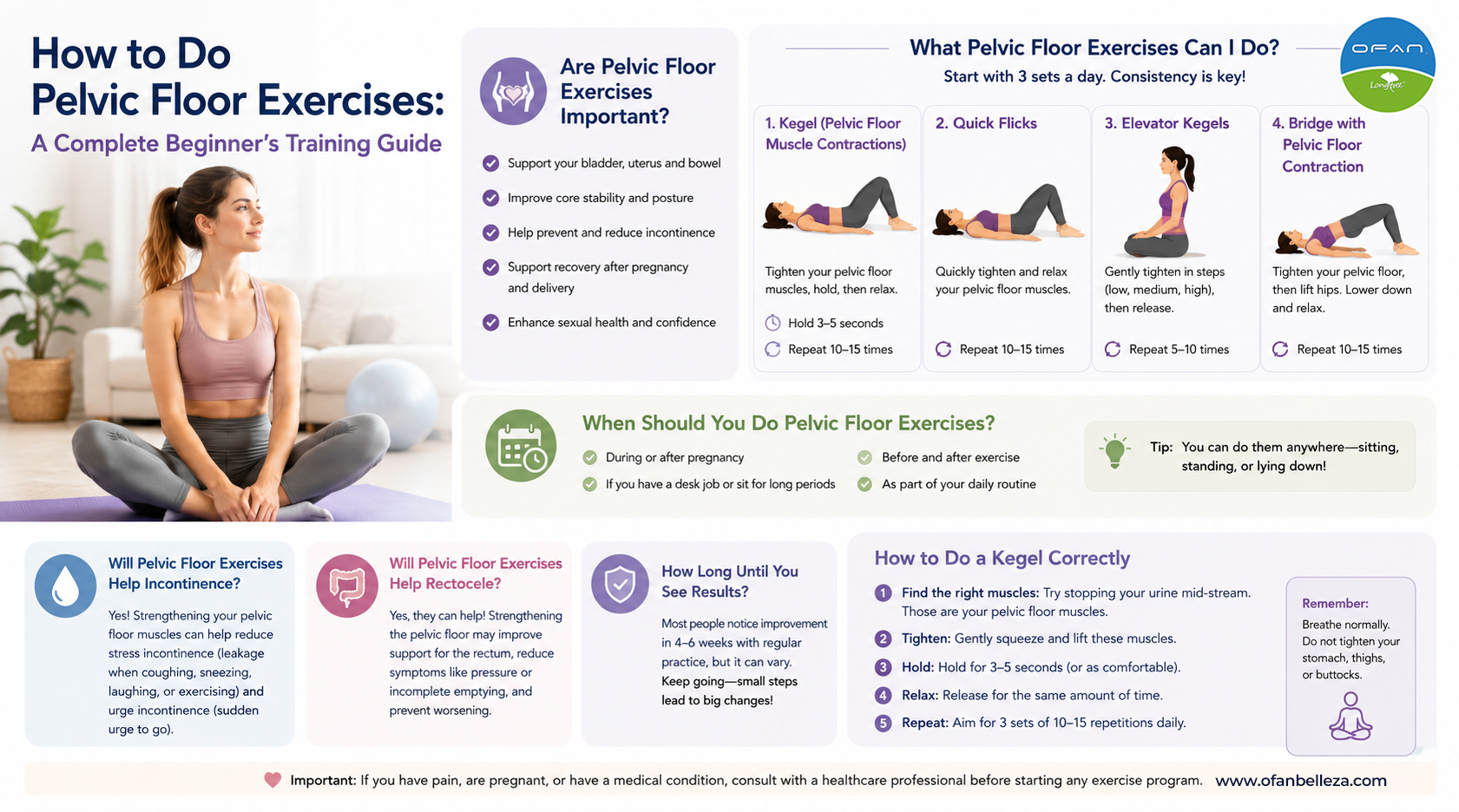
Are Pelvic Floor Exercises Important?
Yes, pelvic floor exercises are important for many people because the pelvic floor supports the bladder, uterus, rectum, and bowel control system. Good pelvic floor function helps with urine control, bowel control, pelvic organ support, sexual function, posture, and pressure management during coughing, lifting, running, or jumping.
But pelvic floor training is not simply “squeeze harder.” A beginner must first learn how to find the right muscles, breathe normally, relax fully, and choose the right exercise for the real problem. Weak muscles may need strengthening. Tight or painful muscles may need relaxation first.
What Are Pelvic Floor Exercises?
Pelvic floor exercises are movements designed to improve pelvic floor strength, endurance, power, relaxation, coordination, or a combination of these. They are often called Kegel exercises, but a complete pelvic floor program is broader than Kegels.
Pelvic Floor Exercises May Include
- Slow pelvic floor contractions
- Quick contractions, often called “quick flicks”
- Breathing and pelvic floor relaxation
- Functional contractions before coughing, lifting, or jumping
- Biofeedback-guided training
- Electrical stimulation-assisted training when appropriate
- Bowel coordination training for constipation or rectocele-related symptoms

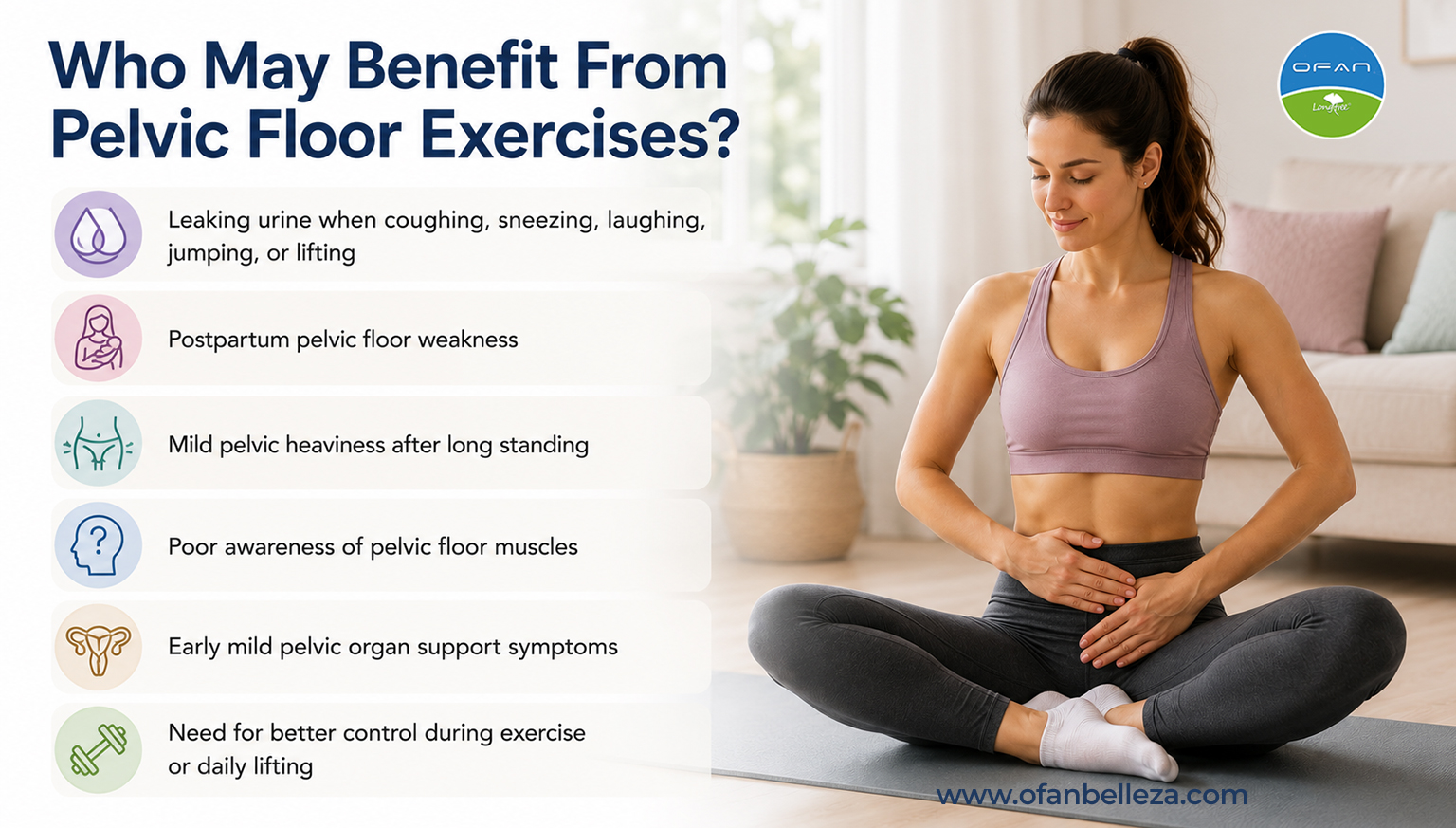
Who May Benefit From Pelvic Floor Exercises?
Pelvic floor exercises may be helpful for people with mild urine leakage, postpartum pelvic floor weakness, early pelvic heaviness, poor bladder or bowel control, or reduced awareness of pelvic floor contraction and relaxation.
Helpful for These Situations
- Leaking urine when coughing, sneezing, laughing, jumping, or lifting
- Postpartum pelvic floor weakness
- Mild pelvic heaviness after long standing
- Poor awareness of pelvic floor muscles
- Early mild pelvic organ support symptoms
- Need for better control during exercise or daily lifting
Be Careful in These Situations
- Pelvic pain or tailbone pain
- Pain during sex
- Rectal pain or perineal pain
- Difficulty emptying the bladder or bowel
- Symptoms that worsen after Kegels
- Severe prolapse or obvious vaginal bulge
- Recent pelvic surgery
Step 1: Find the Right Pelvic Floor Muscles
To identify the pelvic floor muscles, imagine holding back gas and stopping urine flow at the same time. You should feel a gentle inward and upward lift around the vagina and rectum. This is only a way to identify the muscles, not a habit to practice during urination.
Correct Feeling vs Wrong Feeling
| Gentle inward and upward lift | Pushing downward | You may be increasing pressure instead of lifting |
| Normal breathing | Holding breath | You may be using abdominal pressure too much |
| Buttocks mostly relaxed | Strong buttock squeeze | You may be using glute muscles instead of pelvic floor |
| Lower belly stays soft | Abdomen bulges outward | You may be bearing down |
| Full relaxation after each contraction | Staying tense all the time | Your pelvic floor may become overactive or fatigued |
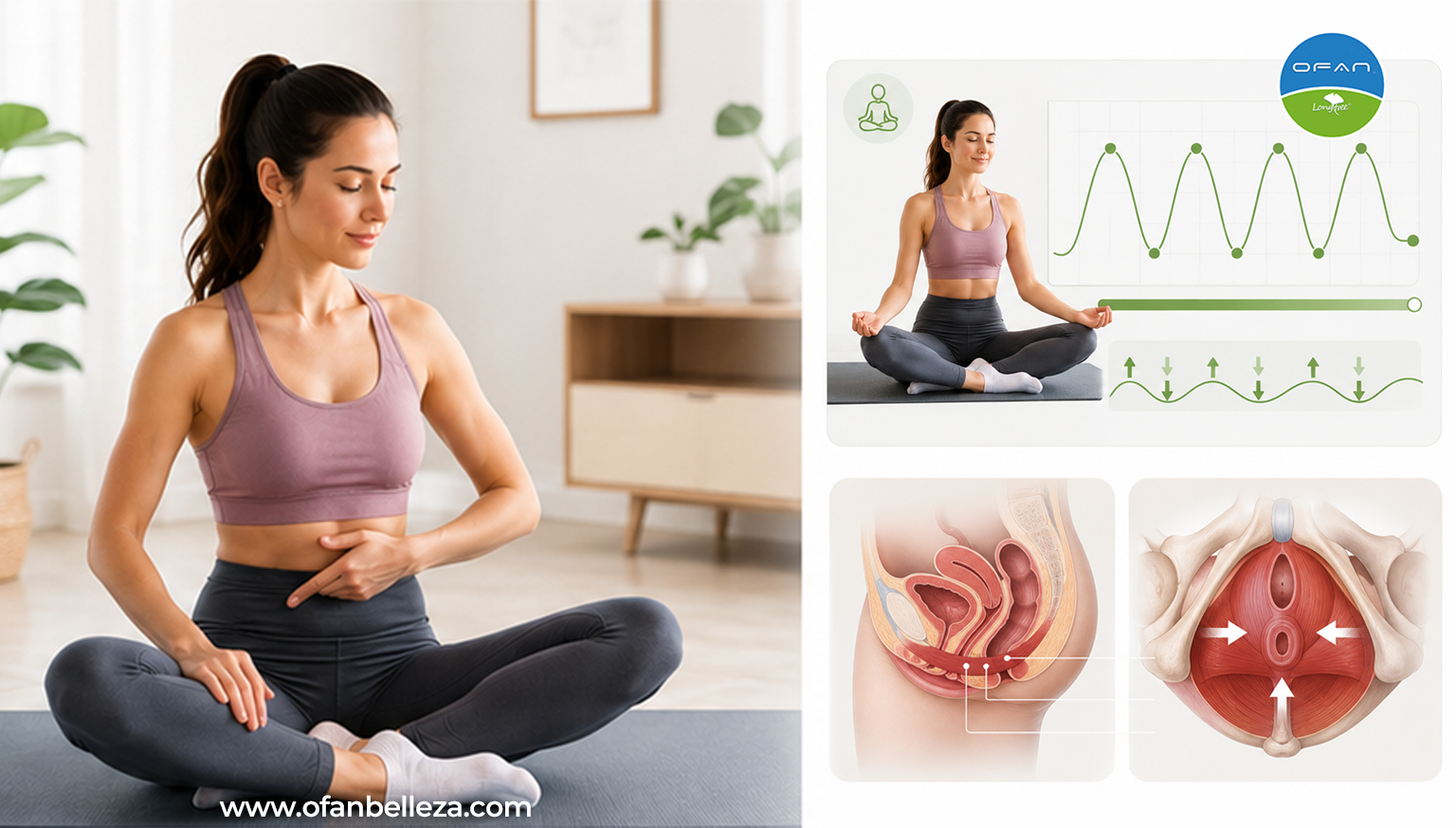
Step 2: Beginner Pelvic Floor Exercises You Can Do
Start with simple exercises. Do not add vaginal weights, strong resistance, or high-intensity exercise until you can contract and relax correctly.
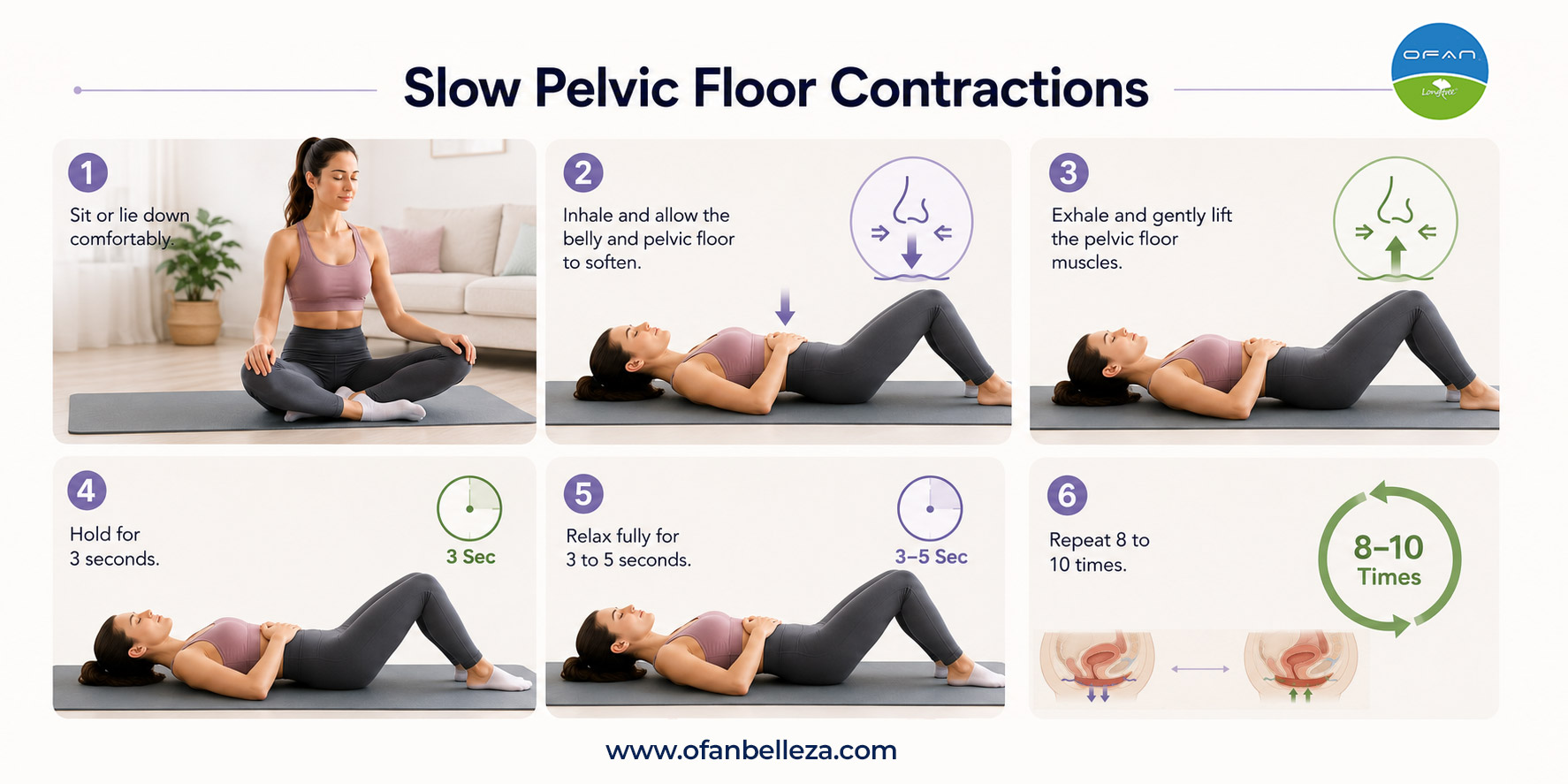
Exercise 1: Slow Pelvic Floor Contractions
- Sit or lie down comfortably.
- Inhale and allow the belly and pelvic floor to soften.
- Exhale and gently lift the pelvic floor muscles.
- Hold for 3 seconds.
- Relax fully for 3 to 5 seconds.
- Repeat 8 to 10 times.
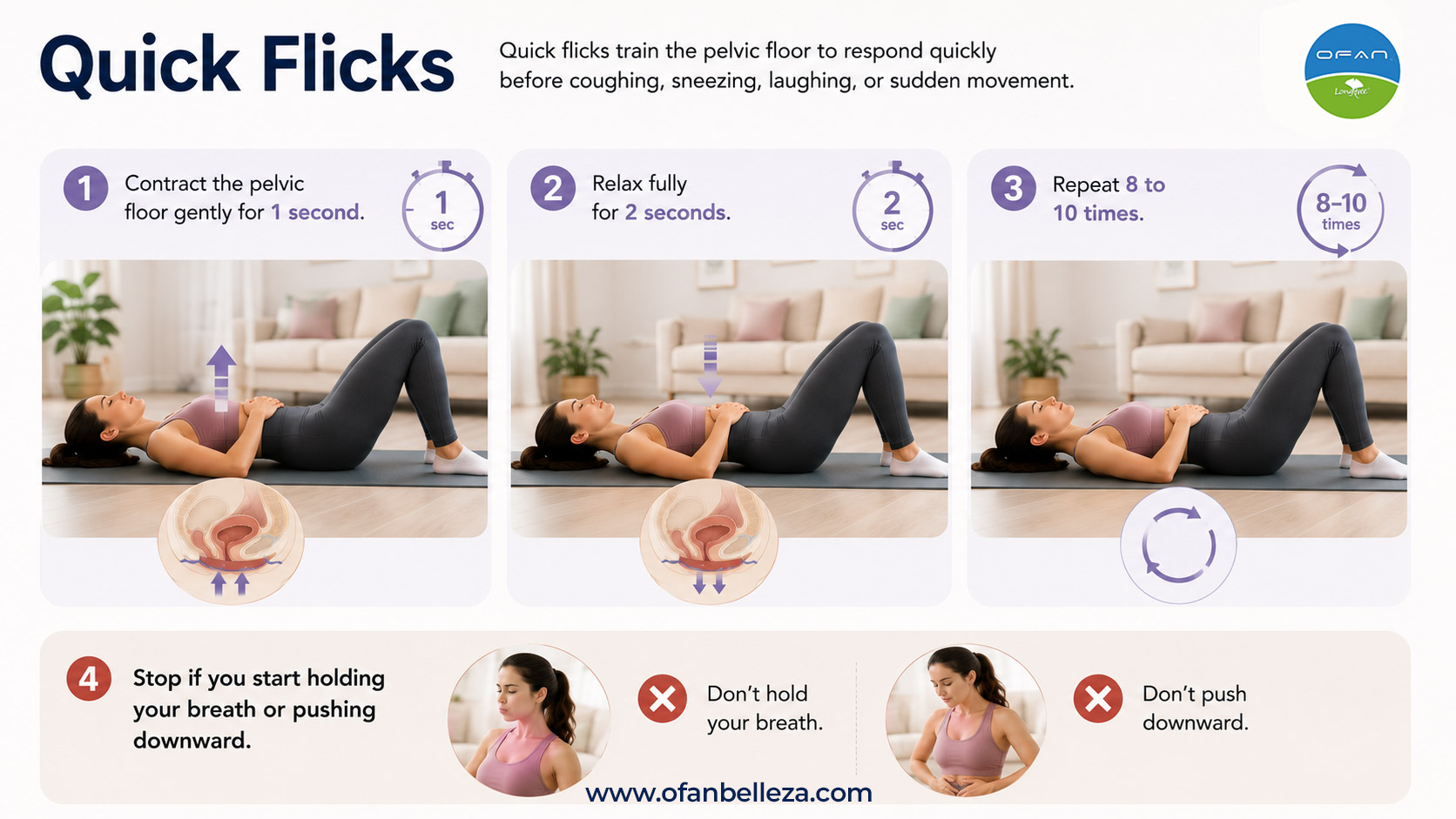
Exercise 2: Quick Flicks
Quick flicks train the pelvic floor to respond quickly before coughing, sneezing, laughing, or sudden movement.
- 1. Contract the pelvic floor gently for 1 second.
- 2. Relax fully for 2 seconds.
- 3. Repeat 8 to 10 times.
- 4. Stop if you start holding your breath or pushing downward.
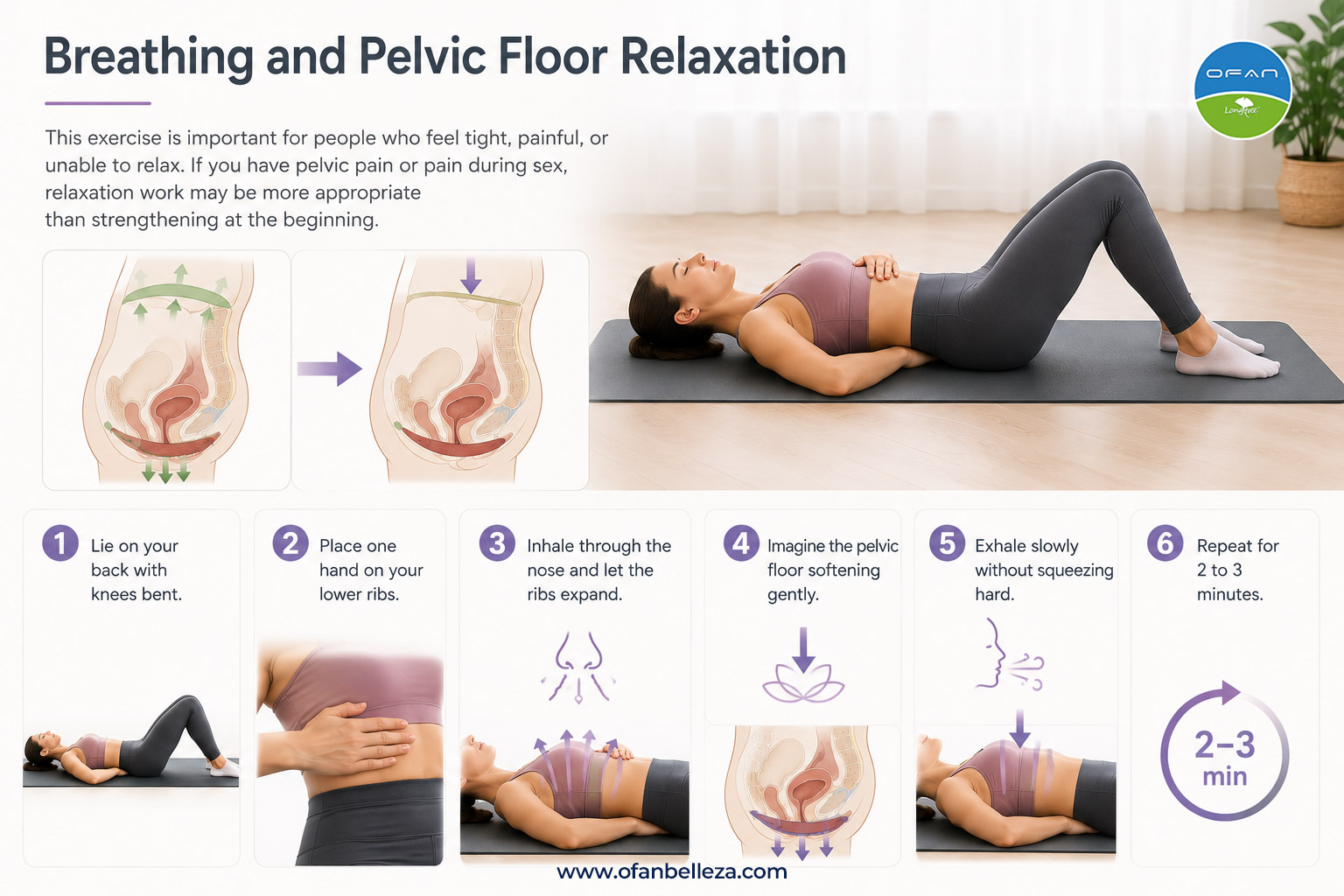
Exercise 3: Breathing and Pelvic Floor Relaxation
This exercise is important for people who feel tight, painful, or unable to relax. If you have pelvic pain or pain during sex, relaxation work may be more appropriate than strengthening at the beginning.
- Lie on your back with knees bent.
- Place one hand on your lower ribs.
- Inhale through the nose and let the ribs expand.
- Imagine the pelvic floor softening gently.
- Exhale slowly without squeezing hard.
- Repeat for 2 to 3 minutes.
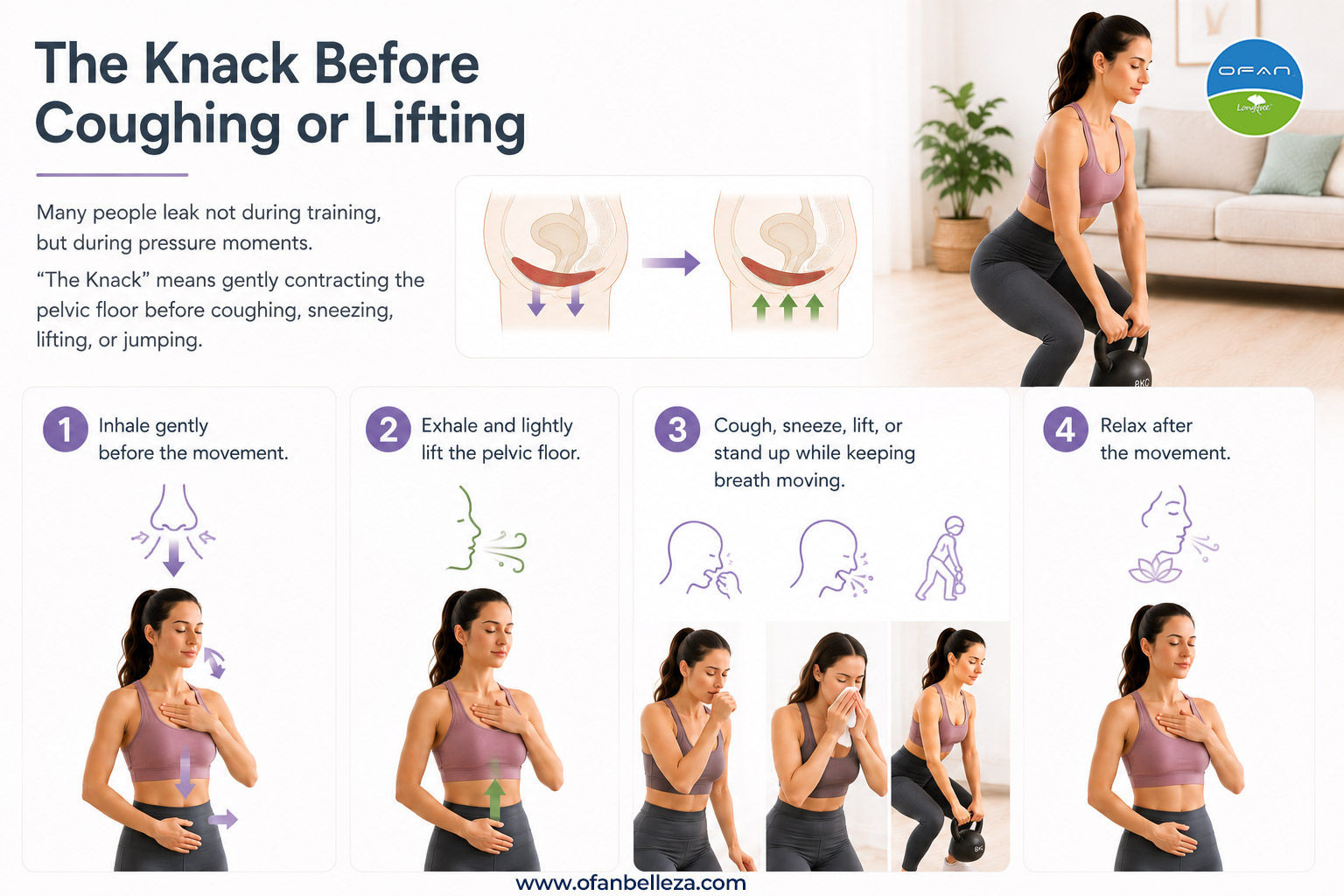
Exercise 4: The Knack Before Coughing or Lifting
Many people leak not during training, but during pressure moments. “The Knack” means gently contracting the pelvic floor before coughing, sneezing, lifting, or jumping.
- Inhale gently before the movement.
- Exhale and lightly lift the pelvic floor.
- Cough, sneeze, lift, or stand up while keeping breath moving.
- Relax after the movement.
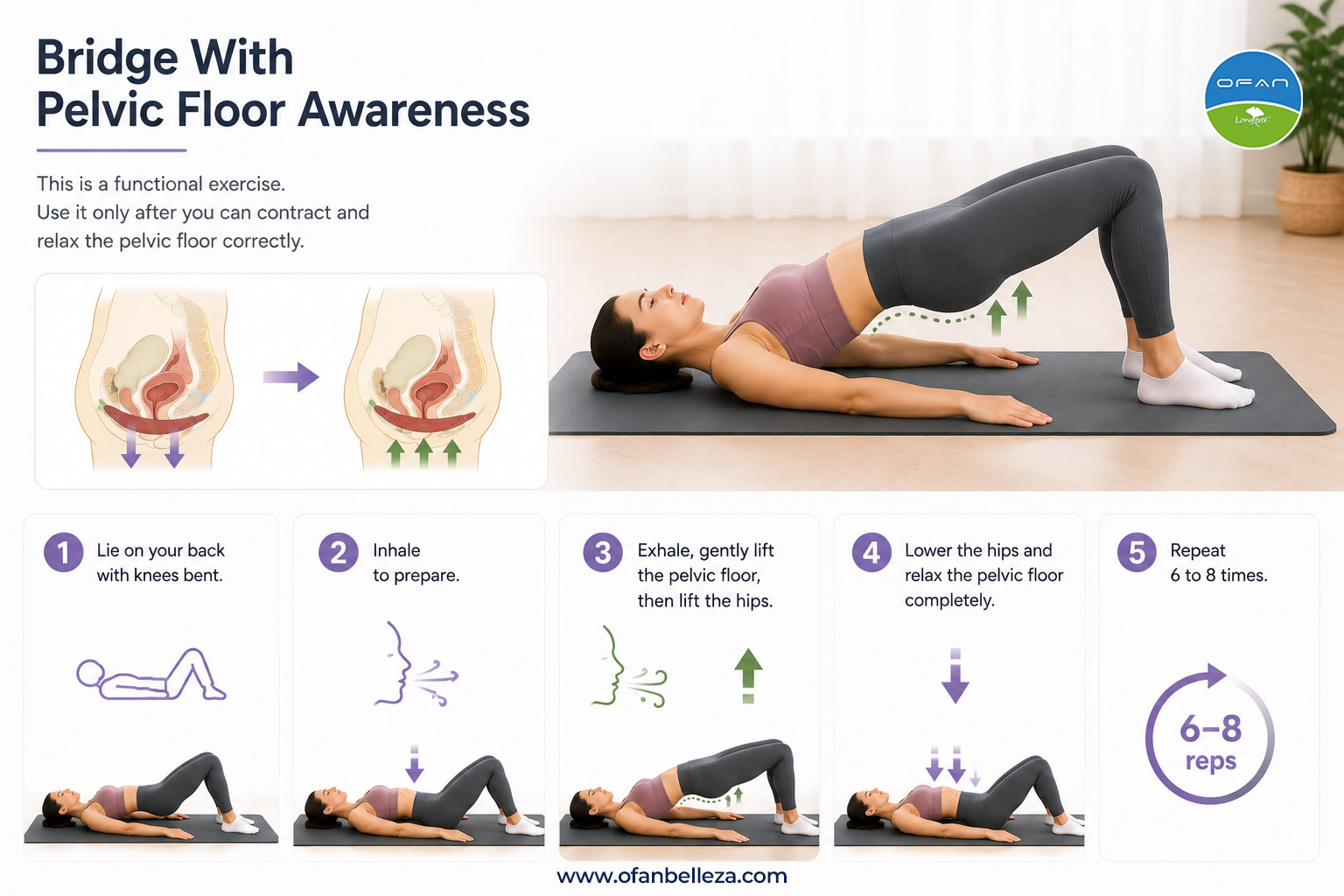
Exercise 5: Bridge With Pelvic Floor Awareness
This is a functional exercise. Use it only after you can contract and relax the pelvic floor correctly.
- Lie on your back with knees bent.
- Inhale to prepare.
- Exhale, gently lift the pelvic floor, then lift the hips.
- Lower the hips and relax the pelvic floor completely.
- Repeat 6 to 8 times.
When Should You Do Pelvic Floor Exercises?
The best time to do pelvic floor exercises is when you can focus, breathe normally, and relax fully between contractions. Short, consistent sessions are better than one long, exhausting session.
Best Training Times
| Time | Why It Works | Best Exercise |
|---|---|---|
| Morning | Easy to build a habit | Slow contractions and breathing |
| Before exercise | Prepares pressure control | Quick flicks and breathing coordination |
| Before coughing or lifting | Trains real-life support | The Knack |
| Evening | Good for relaxation practice | Breathing and down-training |
| Clinic session | Best for technique correction | Biofeedback or therapist-guided training |
When Not to Train
- Do not repeatedly practice by stopping urine midstream.
- Do not train while straining during bowel movements.
- Do not increase intensity when pelvic pain is flaring.
- Do not keep squeezing if you cannot relax afterward.
- Do not self-train aggressively after recent pelvic surgery.
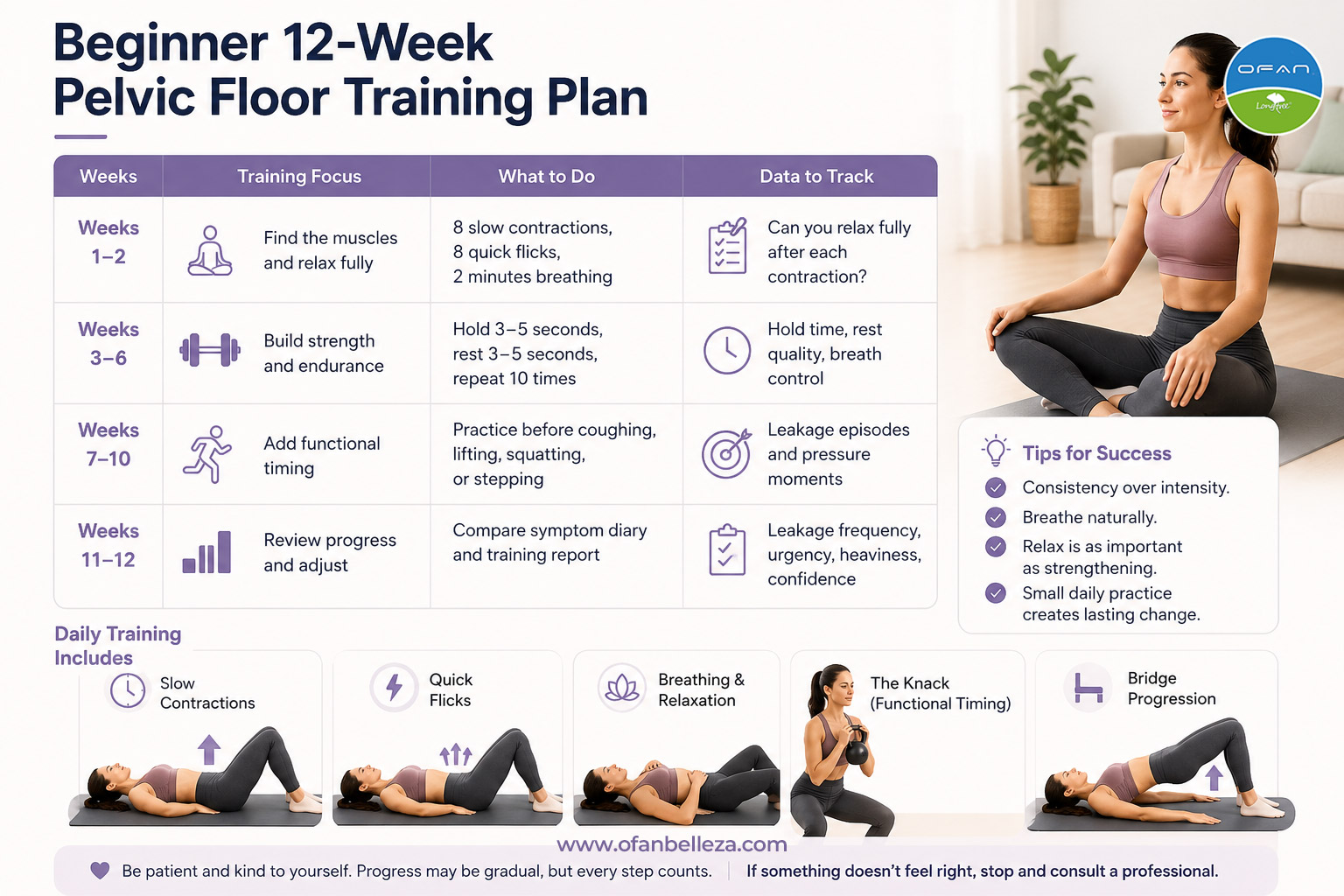
Beginner 12-Week Pelvic Floor Training Plan
Beginners often ask how long it takes to see results. A realistic training plan usually needs weeks to months. Many people notice better awareness first, then better control, then fewer leakage episodes or better function.
| Weeks | Training Focus | What to Do | Data to Track |
|---|---|---|---|
| Weeks 1–2 | Find the muscles and relax fully | 8 slow contractions, 8 quick flicks, 2 minutes breathing | Can you relax fully after each contraction? |
| Weeks 3–6 | Build strength and endurance | Hold 3–5 seconds, rest 3–5 seconds, repeat 10 times | Hold time, rest quality, breath control |
| Weeks 7–10 | Add functional timing | Practice before coughing, lifting, squatting, or stepping | Leakage episodes and pressure moments |
| Weeks 11–12 | Review progress and adjust | Compare symptom diary and training report | Leakage frequency, urgency, heaviness, confidence |
Will Pelvic Floor Exercises Help Incontinence?
Pelvic floor exercises can help many people with urinary incontinence, especially stress urinary incontinence. Stress urinary incontinence means leakage happens when pressure rises during coughing, sneezing, laughing, running, jumping, lifting, or sudden movement.
Exercises may also help mixed urinary incontinence when combined with bladder training, fluid habits, caffeine reduction if appropriate, and professional guidance.
Incontinence Type Comparison
| Type of Incontinence | Typical Trigger | Will Exercises Help? |
|---|---|---|
| Stress urinary incontinence | Coughing, jumping, running, lifting | Often yes |
| Urgency urinary incontinence | Sudden strong urge | May help as part of a plan |
| Mixed urinary incontinence | Stress leakage plus urgency | Often helpful with bladder training |
| Overflow-type leakage | Incomplete emptying or retention | Needs medical evaluation first |
| Leakage with severe prolapse | Bulge, pressure, support changes | May need pessary or specialist care |
Will Pelvic Floor Exercises Help Rectocele?
Pelvic floor exercises may help mild rectocele symptoms by improving pelvic support, muscle coordination, and pressure control. But they usually cannot fully reverse a significant tissue bulge. Rectocele care often needs bowel habit changes, constipation management, pressure control, pelvic floor coordination, and medical evaluation when symptoms affect daily life.
Rectocele Symptoms That Matter
- Vaginal bulge or pressure
- Feeling that stool is trapped
- Incomplete bowel emptying
- Need to press around the vagina or perineum to pass stool
- Constipation and straining
- Pelvic heaviness after standing
- Discomfort during sex
What Exercises Can and Cannot Do for Rectocele
| Can Help With | May Not Fully Fix |
|---|---|
| Pelvic floor awareness | Large tissue bulge |
| Muscle support | Severe structural weakness |
| Pressure control during lifting | Long-term constipation without a bowel plan |
| Coordination during bowel movement | Symptoms needing pessary or surgery |
| Reducing worsening triggers | Advanced prolapse |
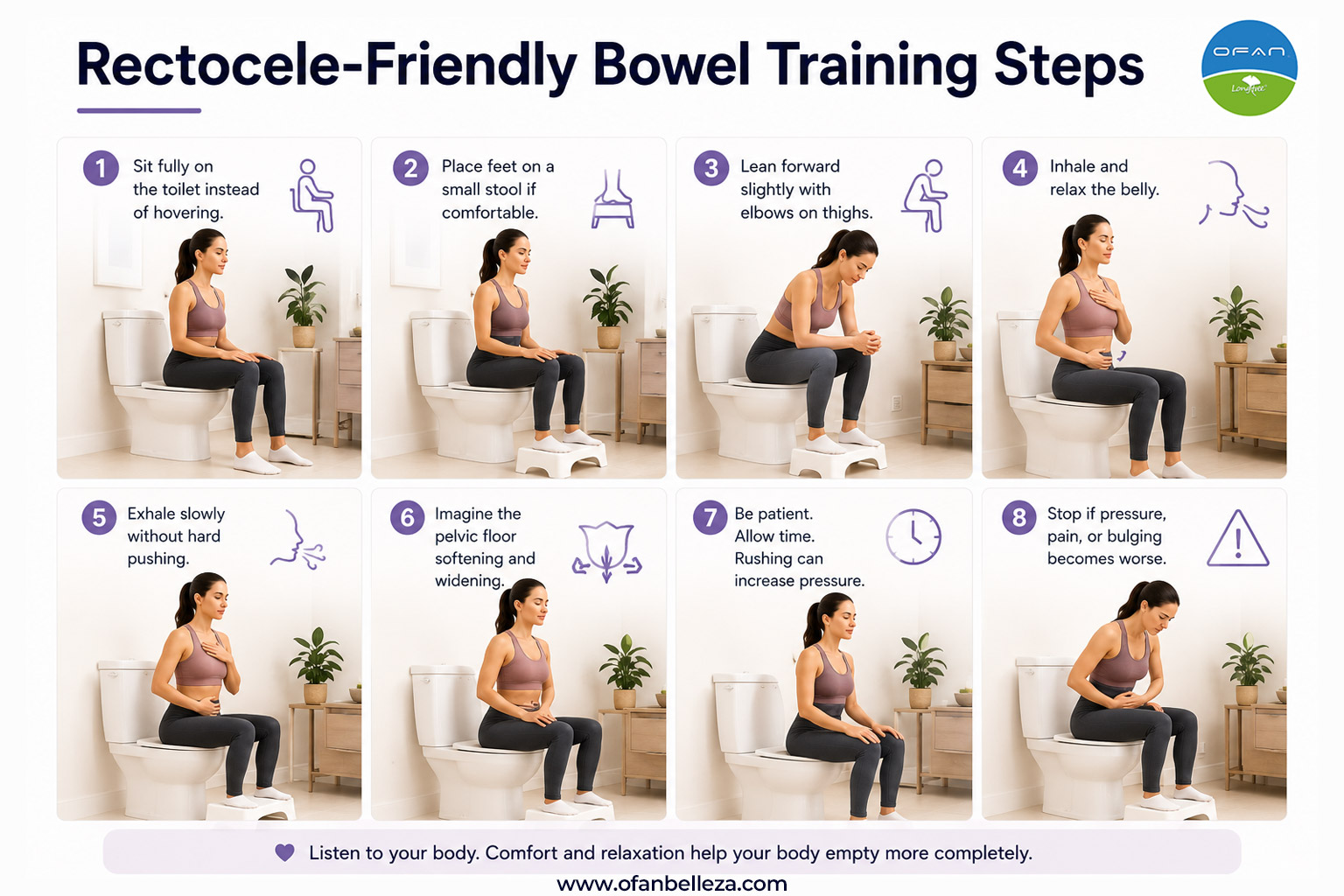
Rectocele-Friendly Bowel Training Steps
- Sit fully on the toilet instead of hovering.
- Place feet on a small stool if comfortable.
- Lean forward slightly with elbows on thighs.
- Inhale and relax the belly.
- Exhale slowly without hard pushing.
- Imagine the pelvic floor softening and widening.
- Be patient.Allow time.Rushing canincrease pressure.
- Stop if pressure, pain, or bulging becomes worse.
Home Exercise vs Biofeedback vs Electrical Stimulation
Home exercises are useful for simple cases, but many beginners cannot tell whether they are using the right muscles. Biofeedback can make contraction and relaxation visible on screen. Electrical stimulation may be considered when a person cannot voluntarily contract the pelvic floor effectively, but it should be used carefully and with appropriate guidance.
| Method | Best For | Strengths | Limitations |
|---|---|---|---|
| Home pelvic floor exercises | Mild symptoms and good body awareness | Convenient and low cost | Easy to do incorrectly |
| Biofeedback training | Poor muscle awareness or coordination issues | Shows contraction and relaxation visually | Needs correct interpretation |
| Electrical stimulation | Very weak or poorly activated muscles | Can assist muscle activation | Not suitable for everyone |
| Pelvic floor physical therapy | Pain, prolapse, postpartum symptoms, complex cases | Individualized assessment and correction | Requires appointment and cost |
For distributors How to Choose OFAN Pelvic floor Machine
Need help choosing the right pelvic floor therapy device? Contact OFAN today👉Get Quote Nowto discuss your project, product requirements, and cooperation plan.
👉Contact OFAN for OEM/ODM Pelvic Floor Therapy Device Solutions
👉READ MORE
👉Click to View: Pelvic Floor Therapy Machine
Professional Buyer’s Guide: How to Choose Pelvic Floor Training and Therapy Devices
For clinics, rehabilitation centers, postpartum recovery providers, distributors, and women’s health brands, pelvic floor devices should not be selected only because they have modern appearance.
What Buyers Should Compare
| Feature | Why It Matters | Buyer Question |
|---|---|---|
| Biofeedback display | Helps patients see contraction and relaxation | Does the screen show both squeeze and release? |
| Training programs | Supports beginners, postpartum users, and rehab cases | Are programs adjustable for different symptoms? |
| Electrical stimulation settings | Important for weak or poorly activated muscles | Can trained staff adjust parameters safely? |
| OEM/ODM support | Important for distributors and private-label brands | Can the supplier customize appearance, functions, or software? |
OFAN Pelvic Floor Therapy Device Solutions
Since 2008, OFAN has focused on the design and manufacturing of pelvic floor therapy technology devices. As an Aesthetic and Healthy Manufacturer, OFAN supports clinics, distributors, rehabilitation centers, postpartum recovery businesses, aesthetic health providers, and women’s health brands with professional pelvic floor therapy equipment.
OFAN supports OEM/ODM cooperation, including product appearance customization, functional configuration, software interface support, private-label projects, and cooperation plans for different market needs.
If you are looking for pelvic floor therapy devices for your clinic, brand, distribution business, or private-label product line, contact OFAN to learn more about available models, technical support, customization options, and cooperation opportunities.
Contact OFAN for OEM/ODM Pelvic Floor Therapy Device Solutions
OFAN Professional Aesthetic & Rehab Equipment Manufacturer | Official Website: www.ofanbelleza.com
👉Get Quote Now
Common Beginner Mistakes
- Holding the breath during every contraction
- Squeezing the buttocks instead of the pelvic floor
- Pushing downward instead of lifting upward
- Doing too many repetitions too soon
- Never relaxing between contractions
- Using vaginal weights before mastering basic control
- Continuing Kegels even when pain or urgency becomes worse
When to See a Doctor or Pelvic Floor Therapist
Seek professional help if you have pain, bleeding, obvious vaginal bulge, severe leakage, urinary retention, difficulty emptying the bowel, recurrent urinary symptoms, symptoms after pelvic surgery, or symptoms that worsen after pelvic floor exercises.
FAQ
Are pelvic floor exercises important?
Yes. They are important for bladder control, bowel control, pelvic organ support, and pressure management. But the right program depends on whether the pelvic floor is weak, tight, painful, or poorly coordinated.
What pelvic floor exercises can I do?
Beginners can start with slow contractions, quick flicks, breathing relaxation, functional pre-contractions before coughing or lifting, and gentle bridge exercises once basic control improves.
When should I do pelvic floor exercises?
Choose times when you can focus and breathe normally, such as morning, evening, before exercise, or before pressure moments like coughing or lifting. Avoid training during urination or while straining during bowel movements.
Will pelvic floor exercises help incontinence?
They often help stress urinary incontinence and may help mixed incontinence as part of a broader plan. Persistent leakage, urgency, or difficulty emptying should be assessed by a healthcare professional.
Will pelvic floor exercises help rectocele?
They may help mild rectocele symptoms by improving support, coordination, and pressure control. However, significant bulging, splinting, or difficult bowel emptying may require medical evaluation, bowel management, pessary discussion, or other treatment.
Final Takeaway
Pelvic floor exercises are useful, but beginners should not treat them as simple squeezing. A complete program includes correct muscle identification, breathing, relaxation, strength, quick response, functional timing, symptom tracking, and professional support when needed.
For patients, the goal is not to do more repetitions blindly. The goal is to train the right muscles in the right way.
Author Bio
This article was written by a pelvic health content editor focusing on women’s health education, pelvic floor rehabilitation, postpartum recovery, and pelvic therapy device buyer guides.
Medical Review
Recommended for review by an OB-GYN, urogynecologist, colorectal specialist, or pelvic floor physical therapist before publication, especially for sections related to diagnosis, contraindications, rectocele, incontinence, and device use.
References
- Mayo Clinic: Kegel exercises: A how-to guide for women
- NICE: Pelvic floor dysfunction: prevention and non-surgical management
- Cochrane: Pelvic floor muscle training for urinary incontinence in women
- Mayo Clinic: Posterior vaginal prolapse, also called rectocele
- ACOG: Pelvic Support Problems
Disclaimer
This article is for health education and product selection reference only. It does not replace medical diagnosis, professional evaluation, or treatment from a licensed healthcare provider. People with pain, bleeding, significant prolapse, urinary retention, bowel emptying difficulty, severe postpartum symptoms, or symptoms after pelvic surgery should seek medical care.


