I wrote this article for clinics, women’s health practices, urology clinics, pelvic health centers, rehabilitation providers, medical spas, wellness centers, and device distributors that need a responsible safety page for pelvic floor chair treatment.
In my view, the safest way to talk about pelvic floor chairs is this: they are non-invasive, but they still require clinical screening.
Pelvic floor chairs use electromagnetic stimulation to activate pelvic floor muscles through clothing. FDA 510(k) summaries for this type of non-invasive pelvic floor stimulation device describe use for rehabilitation of weak pelvic muscles and restoration of neuromuscular control for male and female urinary incontinence.
That does not mean every pelvic floor chair is automatically appropriate for every patient. A clinic should treat it as a medical or wellness technology that needs a screening protocol, not as a casual spa chair.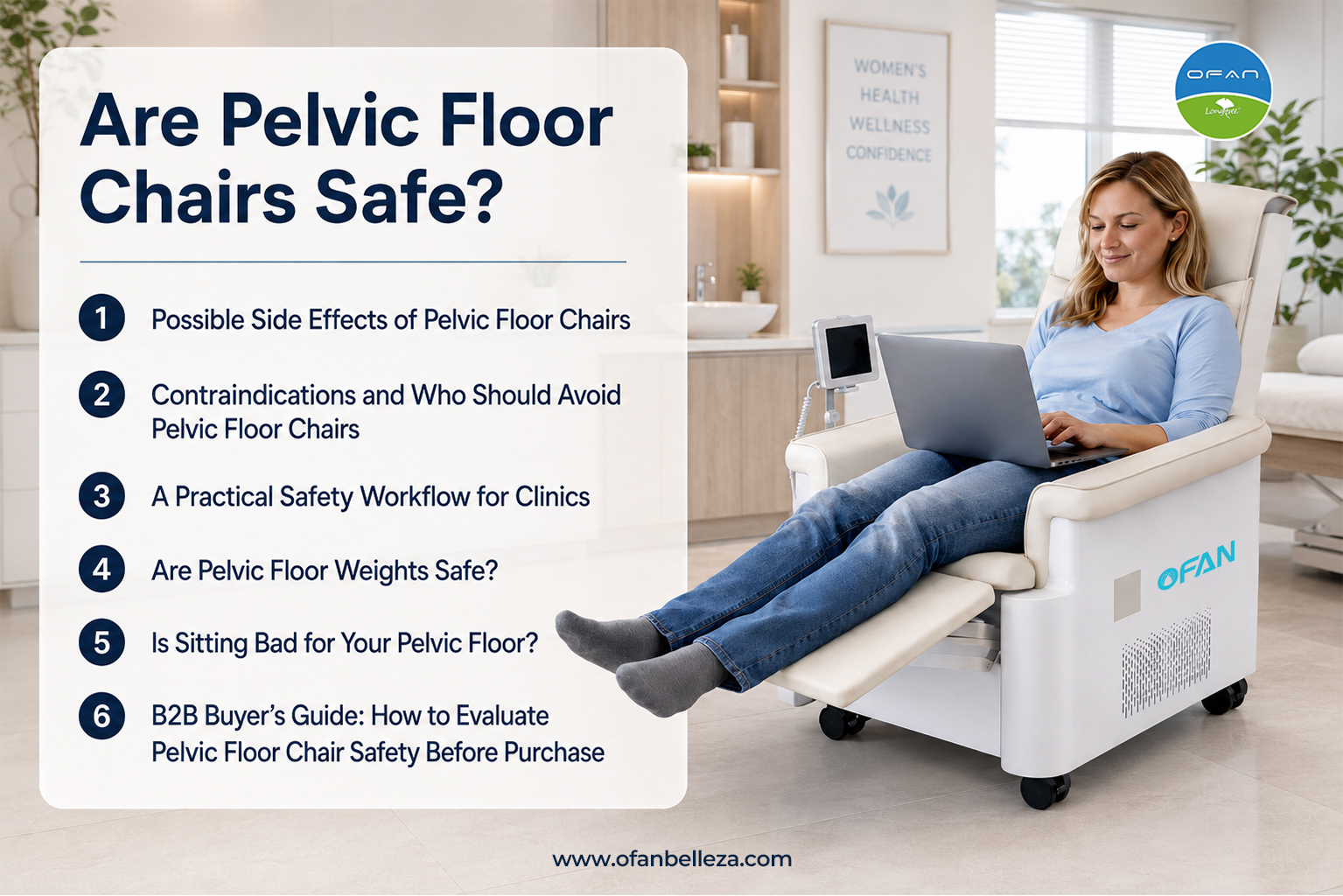
Most patient-facing pages only say “no downtime.” That is not enough for a serious clinic website. A better B2B safety page should clearly explain possible temporary reactions.
| Possible Reaction | What It May Feel Like | Clinic Response |
|---|---|---|
| Muscle soreness | Like a workout sensation in the pelvic, gluteal, or inner thigh area. | Explain before treatment; monitor intensity tolerance. |
| Temporary muscle spasm | Short-lived tightening or twitching. | Pause or reduce intensity if uncomfortable. |
| Temporary joint or tendon discomfort | Local discomfort around hips, pelvis, or lower back. | Document and reassess before next session. |
| Temporary increase in local circulation | Warmth or pulsing sensation. | Usually monitor; stop if unusual pain occurs. |
| Increased sensitivity during intercourse | Temporary sensitivity reported by some patients. | Discuss privately and document if clinically relevant. |
| Local erythema or redness | Temporary skin redness in contact areas. | Check positioning, clothing, and session tolerance. |
The exact contraindication list depends on the device, manufacturer labeling, country, and clinical setting. The list below is a practical screening framework for clinics, not a replacement for the official device manual.
| Screening Item | Why It Matters | B2B Action |
|---|---|---|
| Pregnancy | Safety protocols vary and elective pelvic stimulation may not be appropriate. | Require physician clearance or exclude based on device labeling. |
| Pacemaker or implanted electronic device | Electromagnetic stimulation may interfere with implanted electronics. | Do not treat unless the device labeling and physician clearance allow it. |
| Metal implants in or near the treatment area | Metal may interact with electromagnetic fields depending on location and device type. | Screen carefully and follow manufacturer instructions. |
| Recent pelvic surgery | Tissues may be healing and symptoms may require medical evaluation. | Delay treatment until cleared by the surgeon or physician. |
| Active infection, fever, or unexplained pelvic pain | Symptoms may indicate a condition that should be diagnosed first. | Refer before treatment. |
| Severe pelvic organ prolapse | May require specialist evaluation and individualized management. | Refer to pelvic health specialist or urogynecology. |
| Seizure disorder or neurological condition | Stimulation protocols may not be appropriate for all neurological patients. | Require medical review and device-specific guidance. |
| Unable to communicate discomfort | Patient cannot reliably report pain, heat, or abnormal sensations. | Avoid treatment or use higher-level medical supervision. |

A safe pelvic floor chair program should not start at the chair. It should start with intake, screening, and expectation setting.
Staff should review contraindications before every first session and again when the patient’s health status changes.
For a first session, I prefer a conservative approach: adjust intensity gradually, ask the patient to describe the sensation, and stop if there is sharp pain, unusual heat, dizziness, or distress.
| Item to Track | Why It Matters |
|---|---|
| Session intensity and duration | Helps standardize protocol. |
| Comfort score, 1–10 | Identifies tolerance trends. |
| Leakage frequency | Tracks meaningful outcome. |
| Temporary soreness or spasm | Supports safety monitoring. |
| Reason for discontinuation | Improves protocol and training. |
Pelvic floor weights or vaginal cones can be useful for selected patients who need progressive strengthening and can already contract and relax the correct muscles. But they are not automatically safer or better than chair-based treatment.
| Category | Pelvic Floor Chair | Pelvic Floor Weights |
|---|---|---|
| Invasiveness | Non-invasive; treatment through clothing. | Inserted vaginally; not suitable for all patients. |
| Patient effort | Low during the session. | Requires correct muscle activation and control. |
| Best for | Selected patients with weak pelvic muscles or urinary leakage who prefer non-invasive care. | Selected patients who need progressive strengthening and can use the device correctly. |
| Main safety concern | Contraindications related to electromagnetic stimulation and patient suitability. | Pain, irritation, infection risk, excessive load, or worsening tight pelvic floor symptoms. |
| B2B role | Clinic treatment service line. | Home training accessory or therapist-guided progression tool. |
Sitting itself is not automatically bad for the pelvic floor. The problem is usually long, uninterrupted sitting combined with poor posture, shallow breathing, hip stiffness, constipation, or chronic guarding.
| Patient Question | Better Answer |
|---|---|
| Is sitting bad for your pelvic floor? | Not always. Long sitting can contribute to stiffness and poor pressure management, but posture breaks and breathing can help. |
| Should patients do Kegels while sitting all day? | Not repeatedly without assessment. Some patients need relaxation, not more tightening. |
| What should office workers do? | Stand up regularly, breathe, relax the abdomen and pelvic floor, walk briefly, and avoid straining. |
For clinics and distributors, safety should be part of the buying decision from day one. The best device is not only the one with strong marketing materials; it is the one with clear labeling, training, screening support, service documentation, and realistic claims.

👉Contact OFAN for OEM/ODM Pelvic Floor Chair Solutions
👉Click to View: Pelvic Floor Chair Machine
👉READ MORE
Common Mistakes Clinics Make
No pelvic floor chair program should claim it is safe for everyone. Safety depends on screening, medical history, device labeling, and patient monitoring.
Patients with pain, constipation, urinary hesitancy, or spasms may not need more contraction. They may need relaxation-first therapy and specialist assessment.
Even temporary soreness or discomfort should be documented. This protects the patient, the clinic, and the quality of the program.
Pelvic floor chairs are generally considered non-invasive for selected adults when used according to device instructions and proper screening. They are not automatically appropriate for every patient, especially people with contraindications or red-flag symptoms.
They may be good for selected patients with weak pelvic floor muscles or urinary leakage who prefer non-invasive treatment. They may not be appropriate for patients with pelvic pain, tight pelvic floor symptoms, or complex conditions without professional evaluation.
Possible temporary reactions may include muscle soreness, temporary muscle spasm, temporary joint or tendon discomfort, local redness, increased local circulation, or increased sensitivity. Clinics should document symptoms and adjust or stop treatment if needed.
Patients with pregnancy, implanted electronic devices, relevant metal implants, recent surgery, active infection, unexplained pelvic pain, severe prolapse, seizure disorders, or inability to report discomfort may need to avoid treatment or obtain medical clearance first.
Sitting is not automatically bad. Long, uninterrupted sitting with poor posture, shallow breathing, constipation, or chronic tension may contribute to symptoms. Movement breaks, breathing, and posture education are more useful than simply blaming sitting.
Recliners are not automatically bad. They may become a problem if a patient stays in a slumped position for long periods, holds the breath when standing up, or already has pelvic pain, hip stiffness, constipation, or prolapse symptoms.


